
Home security cameras are legal in Queensland and rarely cause trouble. Problems usually come from three places: cameras aimed at neighbours, sound recording, and businesses or buildings that have not thought about privacy.
This is a general overview from installers, not lawyers. If you have a dispute, a rental property or a business handling personal information, get legal advice rather than relying on a web page.
Installing cameras on your own home to record your own property is lawful in Queensland. A home system needs no permit or registration, you need not notify anyone, and there is no limit on the number of cameras.
The federal Privacy Act 1988 generally does not apply to someone recording their own home for personal or household reasons. That is the main reason home cameras are treated differently from business systems.
The exemption is for protecting your property, not for watching a person. A camera deliberately pointed into a neighbour’s bedroom, bathroom or yard is a different matter. The Queensland Criminal Code includes offences for recording people in private places or during private acts without consent.
Repeatedly aiming a camera at a neighbour can also be treated as harassment or nuisance, even where no recording offence applies. The purpose of the camera counts, not only where it is mounted.
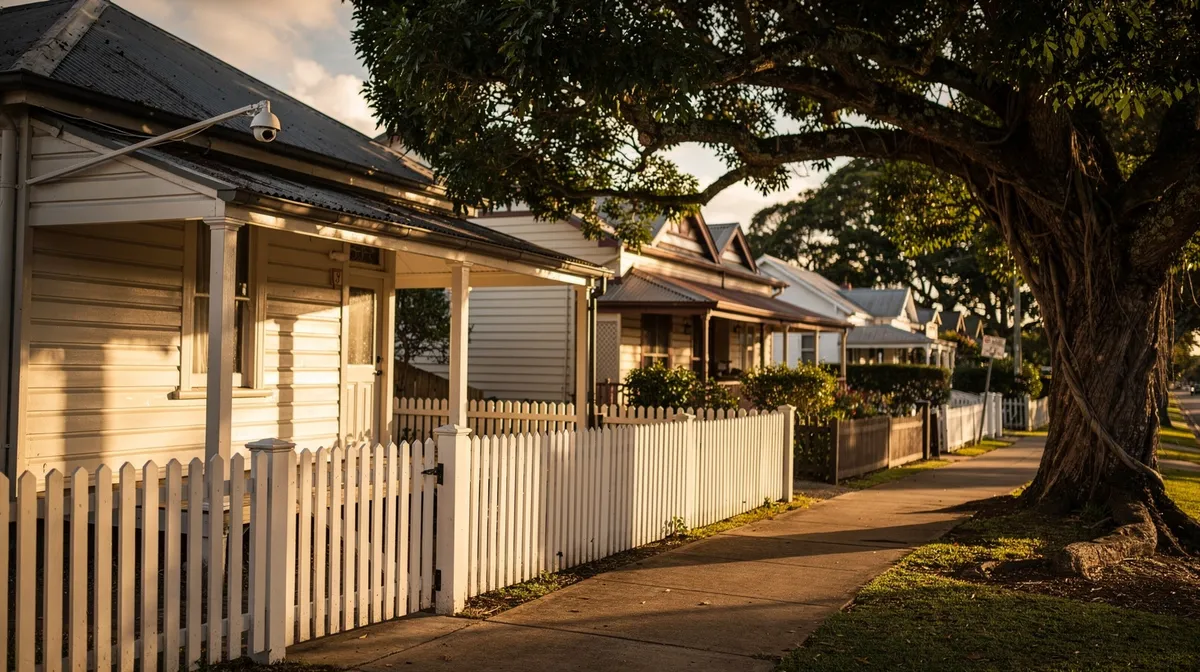
On narrow inner city lots, where houses can be a metre or two apart, this needs extra care. Aim each camera at your own entries, and where part of a neighbour’s window or yard is in view, use a privacy mask so that area is never recorded.
A front gate camera on an inner city home almost always sees some footpath and street. That is generally accepted as part of protecting your property, since nobody expects privacy walking down a public street.
Masking the public area is still worth doing. It keeps the recording on your property and stops the alerts every time someone walks a dog past, which on a busy street can be dozens of times a day.
This is where people slip up. Queensland’s Invasion of Privacy Act restricts using a listening device to record a private conversation you are not part of. A microphone that picks up conversations on the footpath or next door comes close to that line.
Most cameras arrive with the microphone switched on. We turn it off unless there is a clear reason to use it. Speaking through a doorbell to a courier is not the same as a microphone recording everything in range for weeks.
In an apartment building, corridors, lobbies, car parks and outside walls are usually common property. Cameras there need body corporate approval, and the by-laws may also cover doorbell cameras on your own door. Building cameras should have a clear purpose, limited viewing and a set period for keeping footage.
A business does not get the household exemption. Footage of identifiable people is personal information, and organisations covered by the Privacy Act, generally those turning over more than $3 million a year plus some others of any size, have rules on how it is collected, kept, used and shared.
In practice that means signs at each entry, a clear reason for every camera, no cameras in toilets or change rooms, telling staff before cameras cover their work areas, limited access to footage, a set retention period and a way to handle requests for footage, including from police. Smaller businesses below the threshold are not bound the same way, but signs and a sensible retention period still help.
Landlords can cover the outside of a rental and shared areas, but not the inside of a tenant’s home. Cameras at a leased property should be in the lease, and at a short stay they should be in the listing and kept away from the spaces guests use. Get advice before installing anything at a tenanted property.
If police ask for footage, provide it. Copying a clip to a USB stick takes a couple of minutes on every system we install, and we show each customer how.
Posting the same clip online is where people get into trouble. Naming and accusing someone publicly, especially the wrong person, can lead to a defamation claim.
Recording your own property is fine. Some footpath and street is generally fine, though masking it is better. Aiming at a neighbour’s private areas is not. Recording conversations you are not part of is restricted. Apartments need body corporate approval for common areas. Businesses need signs, a purpose for each camera, limited access and a retention period. Rentals need advice first.
None of this is legal advice. For a dispute, see a solicitor, and for business privacy duties, start with the Office of the Australian Information Commissioner.
Catching some of the footpath is common and generally accepted. Masking the public area keeps the recording on your property and reduces false alerts.
There is no general rule for a home system, but telling them avoids most disputes. On a narrow lot, it is well worth doing.
Be careful. Queensland law restricts recording private conversations you are not part of, so we leave microphones off unless there is a clear reason and you have taken advice.
It can cause you trouble. Publicly naming or accusing someone can lead to a defamation claim. Give the footage to police instead.
Installed prices, what pushes a quote up, and what a very cheap quote usually leaves out.
PlanningHow to count the ways onto your property and turn that into a camera number.
Buying adviceHow wired, wifi and battery cameras compare, and where each one makes sense.
HiringThe licences to ask for, what a full quote lists, and the warning signs.
Buying adviceHow the three brands we fit most compare, and which specifications actually change your footage.
Four camera 4K home systems from $1,690 installed, planned for Queenslanders, cottages and townhouses.
CommercialCafes, shops, studios and offices, with weeks of recording and a login for each staff member.
RepairsOffline cameras, beeping recorders, broken apps and old analogue systems repaired or replaced.
DeterrenceSiren, strobe and spoken warning cameras, from $1,890 for four installed.
Cameras and cabling in Norman Park 4170.
4000Cameras and cabling in Spring Hill 4000.
4005Cameras and cabling in Teneriffe 4005.
4171Cameras and cabling in Balmoral 4171.
4000Cameras and cabling in Brisbane City 4000.
4169Cameras and cabling in East Brisbane 4169.
Give us a few details about the property and we will send a written, itemised quote.
Thanks. Your details are with Richard (QLD Lic #4930731, ACMA #A058225), who will look over the job and send a written, itemised price within 15 to 30 minutes during trade hours.